Quick answer
- Barcodes (1D) store a little data in lines, ideal for retail, inventory and shipping.
- QR codes (2D) store far more in a grid, ideal for links, menus, payments and marketing.
- Need a checkout SKU? Barcode. Need to send someone somewhere? QR code.
They're cousins, not twins. Both encode data visually, but a traditional barcode and a QR code are built for very different worlds.
What is a barcode?
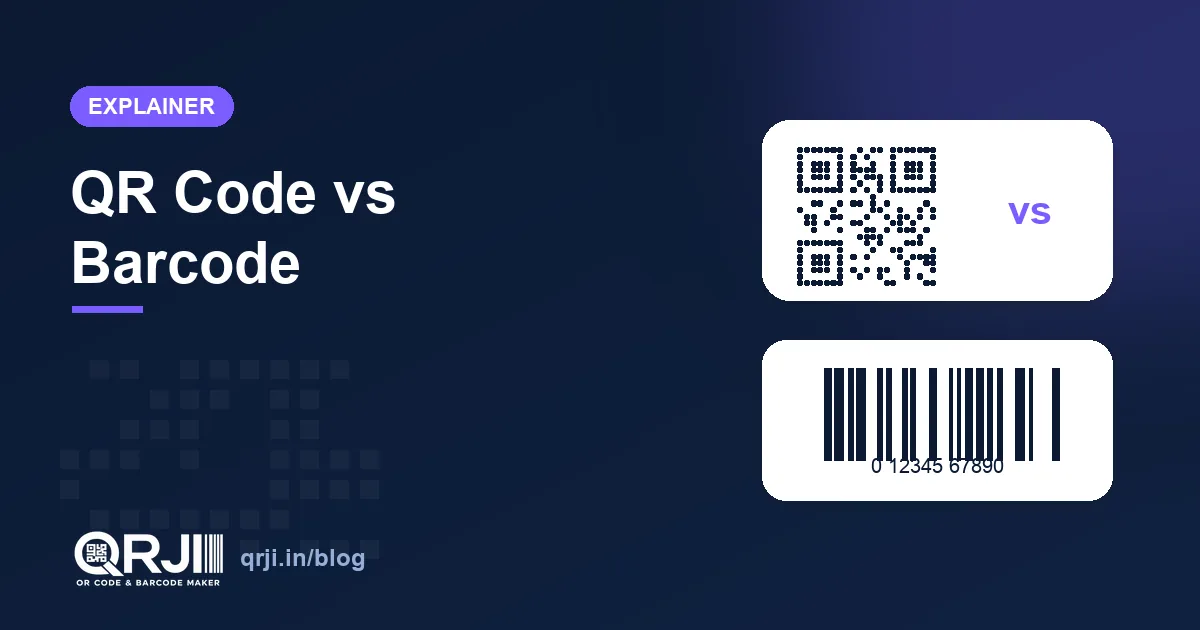
A classic barcode is one-dimensional: a row of parallel lines of varying width, read left to right by a laser scanner. It holds a small amount of data, typically a product number like an EAN-13 or UPC. That's all a till needs to look up a price. Barcodes are the backbone of retail, warehousing and logistics.
What is a QR code?
A QR ("Quick Response") code is two-dimensional: a grid of squares read in both directions by any smartphone camera. Because it uses an area instead of a line, it stores far more: full URLs, contact cards, Wi-Fi credentials, payment details and more. That capacity, plus the fact that everyone carries a scanner in their pocket, is why QR codes dominate marketing and customer-facing uses.
Key differences at a glance
- Data capacity: barcodes hold ~20–25 characters; QR codes hold thousands.
- Scanner: barcodes usually need a dedicated reader; QR codes work with any phone.
- Error tolerance: QR codes still scan when partly damaged or covered by a logo; barcodes don't.
- Best for: barcodes = products & inventory; QR codes = links, content & payments.
Which should you use?
If you're tagging products for a point-of-sale system or tracking inventory, use a barcode (EAN-13 and UPC-A are the retail standards). If you want to send people to a page, menu, form or payment, use a QR code. Many businesses use both: a barcode for the till and a QR code for marketing. QRJI makes both, so you don't need two tools.
Create unlimited dynamic, trackable QR codes and barcodes for just $1/month. Start free →
Frequently asked questions
Is a QR code a type of barcode?
Technically yes: a QR code is a 2D barcode. In everyday use, 'barcode' means the 1D line type and 'QR code' means the 2D square grid.
Can a phone scan a regular barcode?
Many phone apps and the QRJI scanner can read 1D barcodes, but retail systems still use dedicated laser scanners for speed.
Which holds more data, a barcode or a QR code?
A QR code, by far. Barcodes store around 20–25 characters; QR codes can store thousands.
Related articles
How to Create a QR Code in 2026 (Free, Step-by-Step)
The complete beginner's guide to making your first QR code: what to choose, how to brand it, and how to make sure it always scans.
Dynamic vs Static QR Codes: Which One Should You Use?
They look identical, but the difference can make or break your campaign. Here's exactly when to use each, and why it matters.
QR Code Menus for Restaurants: The Complete Guide
From table tents to update-anytime menus, here's how cafés and restaurants use QR codes to save money and sell more.
Ready to create your code?
Dynamic QR codes, barcodes, analytics and bulk tools, all for $1/month.
14-day free trial · No card required · Cancel anytime